
Road Bike Arrival at Nice Airport: Packing and Transfer Guide
Updated: Aug 5
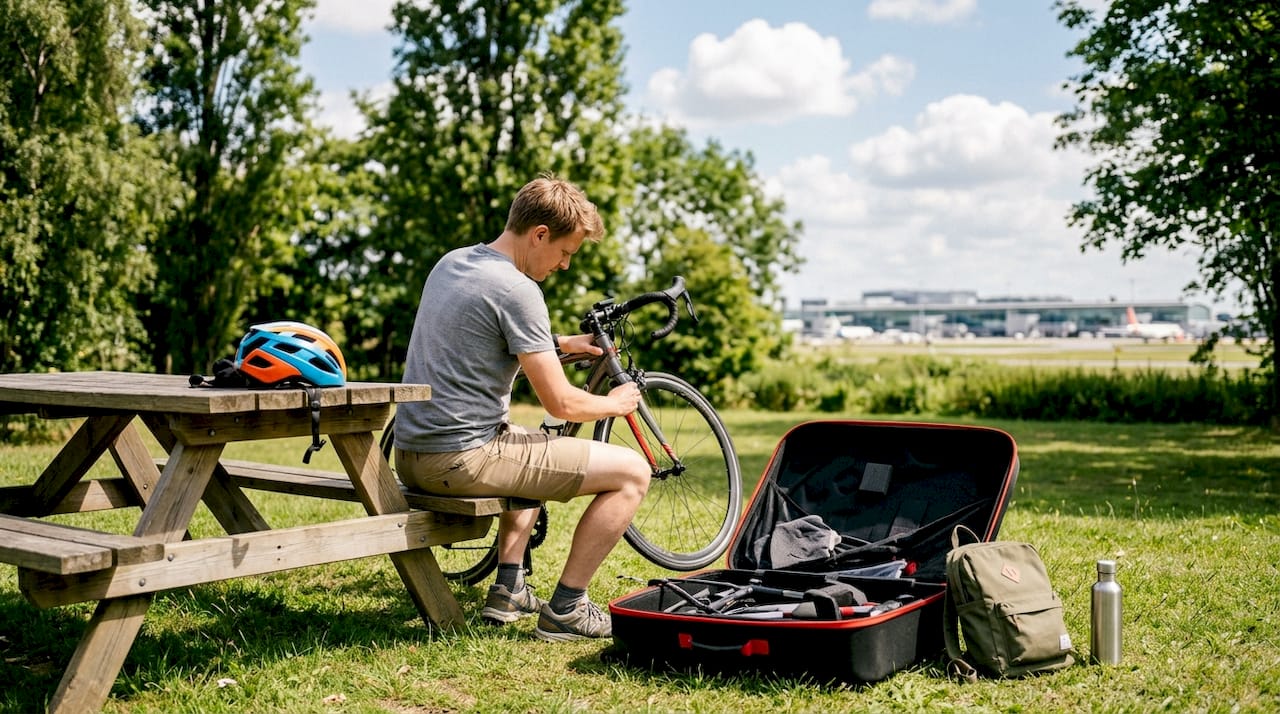
What cyclists need to know about arriving at Nice Airport with a road bike
Getting your road bike from a US airport to the French Riviera in one piece comes down to two things: how well you packed it and what transfer you booked. Nice Airport handles bike boxes regularly, but the airport won’t protect your carbon frame. That responsibility sits entirely with you. The good news is that Nice Airport is genuinely cyclist-friendly, with a designated bike assembly area in the baggage reclaim zone, complete with a workstand and tools. Pair that with a private transfer service that accommodates oversized luggage, and your arrival can be far smoother than most cyclists expect.
Here’s what to keep in mind before you land:
Airlines require bikes to be packed in a hard case, soft bag, or cardboard box; hard cases offer the best protection for carbon frames
Weight limits vary by airline, with many setting thresholds before extra charges apply
US carriers generally charge a fee per bike; check your specific airline before flying
Oversized baggage at Nice Airport is collected from a dedicated carousel or oversized claim area, separate from standard luggage
Public transit from Nice Airport with a bike box is impractical; a private transfer is the most reliable option
Pre-book your transfer and mention your bike so the driver arrives with a vehicle large enough to accommodate it
What are Nice Airport’s official rules for transporting road bikes?
Nice Airport (NCE) follows standard French airport protocols for oversized sports equipment, but the rules that matter most are set by your airline, not the airport itself. Every carrier has its own policy, and the differences can be significant.
Airlines generally accept bikes packed in a hard case, soft bag, or cardboard box. Hard cases are the safest choice for carbon frames, though they’re heavier and often trigger oversized baggage fees. Soft bags pack down more easily and cost less, but offer less structural protection. Cardboard boxes are free from most bike shops and work fine for a single trip, though they provide the least defense against rough handling.
Weight limits: Most airlines set a 50–70 lb (23–32 kg) threshold before surcharges apply; check your carrier’s specific policy
Oversized fees: Bikes frequently qualify as oversized baggage even when under the weight limit; fees vary widely by airline
Customs on arrival from the US: Cyclists arriving from the US clear French customs at NCE. Personal sports equipment for your own use is generally exempt from duty, but declare any high-value items if asked
Security checks: Assume your bike box may be opened and inspected; do not pack CO2 cartridges, aerosols, or any flammable lubricants
Baggage claim: Oversized items including bike boxes are typically delivered to a separate oversized baggage area at Nice Airport, not the standard carousel; follow airport signage after landing
Storage: Airport storage for bike boxes is limited and inconsistent; confirm availability with the airport or your accommodation in advance rather than assuming it exists
One practical note: remove all hazmat and warning stickers from your bike box before checking it. Stickers can trigger delays or fines with certain carriers.
How do you pack a road bike correctly for air travel?
The packing process is where most damage happens, and the responsibility lies with you, not the baggage handlers. Treat every handler as someone who will drop the box. Pack accordingly.
Tools and materials to gather first
Before you touch the bike, collect everything you need:
Allen wrenches in 4mm, 5mm, and 6mm sizes, plus Torx wrenches
Pedal wrench (or 15mm flat spanner)
Foam pipe insulation and bubble wrap
Zip ties and Velcro straps (never tape directly on frame paint)
Disc brake spacers and rotor guards
Axle spacers for the fork and rear dropout
Packing tape and a marker for labeling
Small zip bags for loose parts
An accessory bag for tools and components needed at reassembly
Disassembly step by step
Start by photographing your bike from multiple angles. This takes two minutes and becomes your insurance documentation if anything goes wrong.
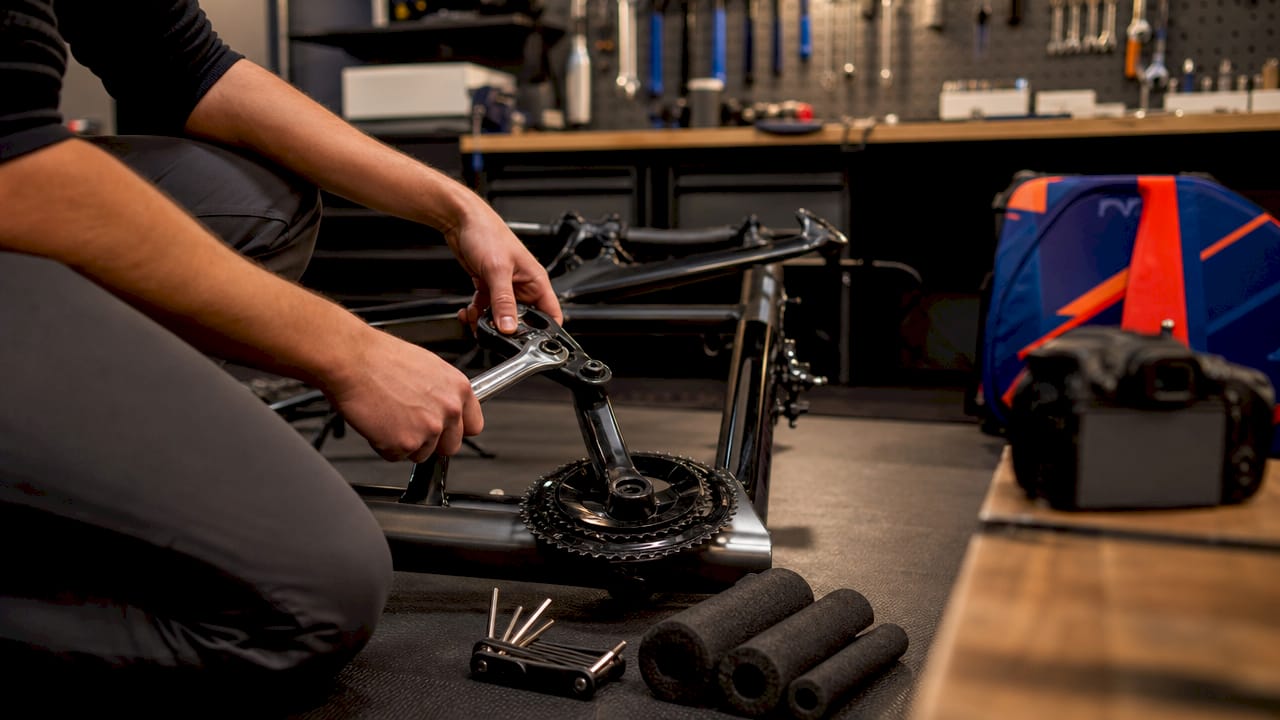
Pedals: Remove both pedals using a pedal wrench or Allen key. The left pedal unscrews clockwise; the right pedal unscrews counterclockwise. Apply grease to the threads before storing them in a zip bag.
Wheels: Remove both wheels. Deflating tires slightly before a flight is common practice, though modern tubeless setups handle altitude pressure changes well. Protect disc rotors with guards or wrap them in stiff cardboard. Bent rotors are one of the most common transit injuries, and they’re entirely preventable.
Handlebars: Loosen the faceplate bolts and remove the bars. Leave cables attached if possible, and secure them carefully against the frame with padding. Mark bar rotation with tape so you can reinstall them at the correct angle.
Rear derailleur: Remove it from the hanger without disconnecting the cables, wrap it in bubble wrap, and zip tie it to the frame. A derailleur left on the hanger is a bent derailleur waiting to happen.
Seatpost: Mark your seatpost height with tape before pulling it. Wrap it in foam and store it separately.
Frame protection: Wrap all tubes with foam pipe insulation, paying particular attention to the fork legs, chainstays, and top tube. Use Velcro straps to secure padding, never tape, which can lift paint.
Packing and final checks
Place the frame in the case first, secured with straps. Add wheels on each side in padded compartments. Fill any gaps with soft clothing or shoes to prevent movement.
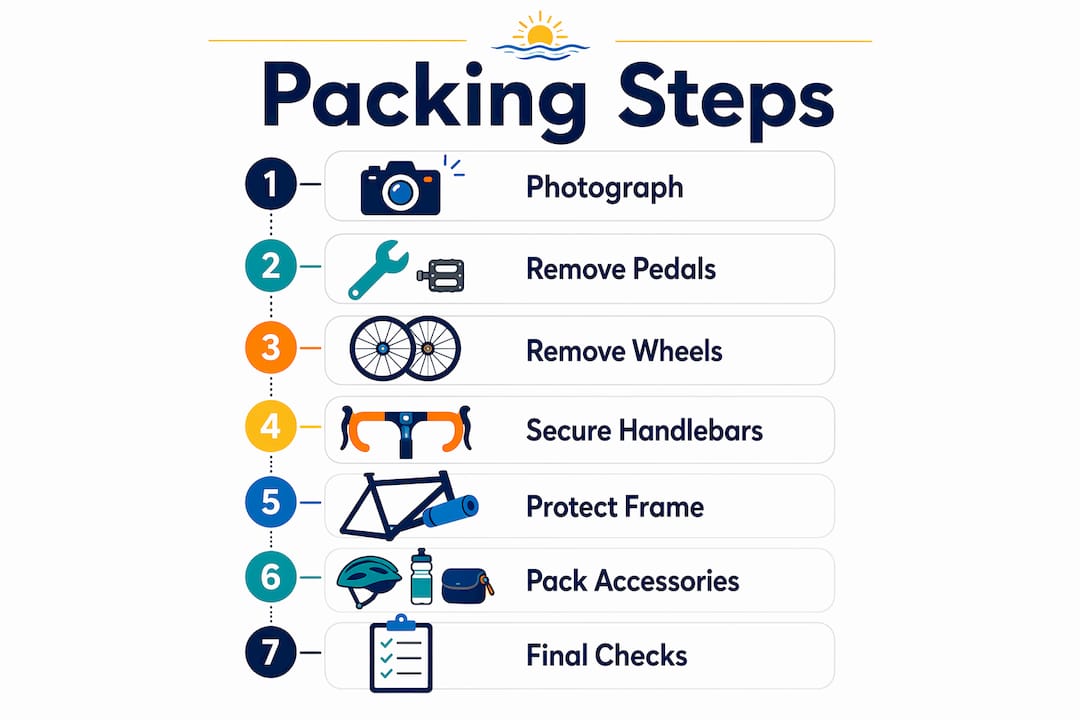
Pro Tip: Keep a dedicated accessory bag inside the case containing your pedals, disc rotors, small bolts, and all tools needed for reassembly. Zip tie it to the rear triangle so it can’t shift around. When you arrive at Nice Airport’s assembly area, everything you need is in one place.
Once the case is closed, shake it. If anything rattles, reopen it and pad further. Label the outside with your name, phone number, and “FRAGILE: BICYCLE.”
What are your best transfer options from Nice Airport with a bike?
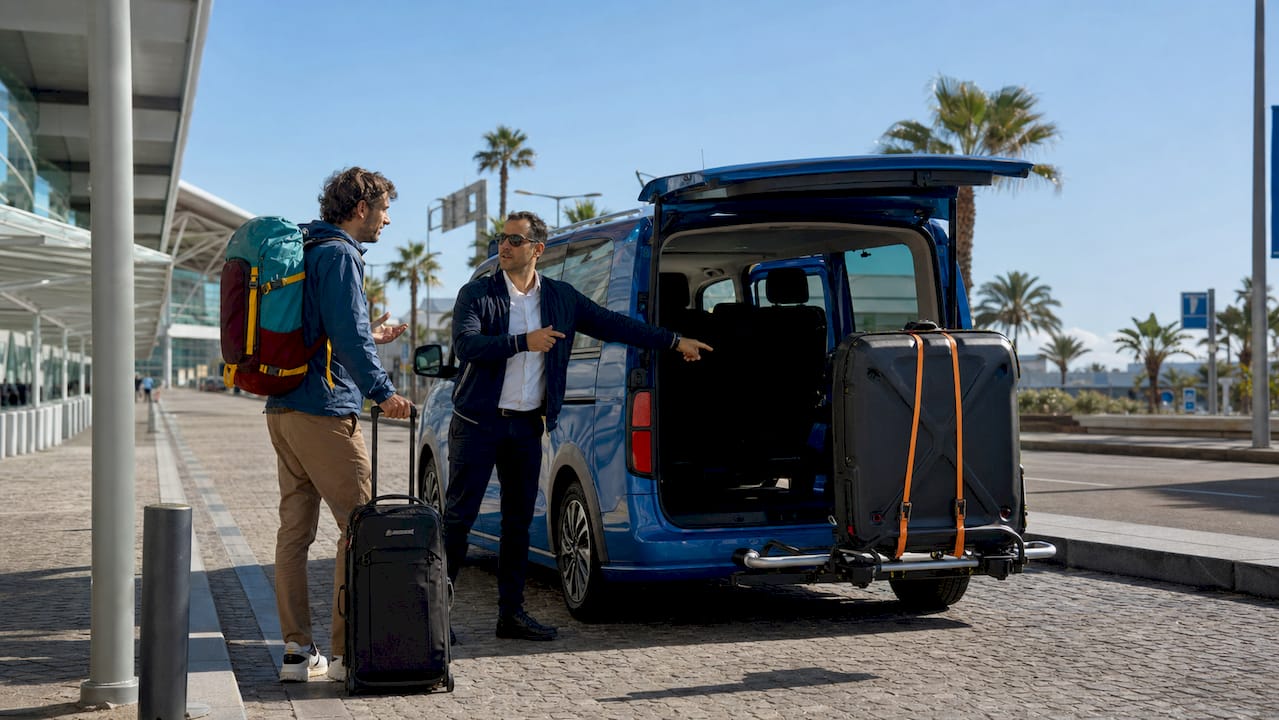
Getting a bike box from the baggage claim to your accommodation on the French Riviera is where many cyclists hit their first real obstacle. Public buses and trams at Nice Airport are not designed for oversized luggage, and standard taxis often refuse bike boxes or charge unpredictable fees for them.
The most practical solution is a private door-to-door transfer. Nice-airport offers private transfers from Nice Airport to destinations across the French Riviera, including Cannes, Monaco, Antibes, Saint-Tropez, Villefranche-sur-Mer, and Èze. Drivers monitor your flight in real time, meet you after baggage collection, and handle the logistics of loading your bike case into a vehicle sized for it. Fixed pricing means no surprises at the end of the ride.
Private transfer (recommended): Book in advance, specify that you’re traveling with a bike box, and confirm the vehicle type. Nice-airport accommodates oversized sports equipment and provides professional drivers familiar with the airport layout
Public transit: The tram and bus lines serving Nice Airport are not practical with a full bike case. Stairs, crowded platforms, and limited space make this a frustrating experience
Standard taxis: Some will take a bike box; many won’t. Pricing is metered and unpredictable, and you may wait through several refusals before finding a driver willing to load an oversized case
Rental cars: Viable if you have a large enough vehicle booked, but loading and unloading a bike case solo adds time and effort at both ends
Pro Tip: When booking your Nice Airport transfer, mention your bike case dimensions and whether you’re traveling with a hard case or soft bag. This lets the service allocate the right vehicle and avoids any last-minute issues at the pickup point.
Nice Airport has two terminals (Terminal 1 and Terminal 2), connected by a free shuttle. Most transatlantic flights arrive at Terminal 2. Confirm your terminal before booking so your driver waits at the correct pickup point.
What local bike services are available at and near Nice Airport?
Nice Airport stands out among European airports for its cyclist-specific infrastructure. A designated bike assembly area in the baggage reclaim zone includes a workstand and basic tools, which means you can reassemble your bike before leaving the airport if you plan to ride directly from NCE. That’s a genuine convenience most airports don’t offer.
On-site assembly area: Located in the baggage reclaim zone; includes a workstand and tools. Useful for cyclists riding out of the airport rather than transferring to accommodation first
Nearby bike shops: Several shops in Nice city center and along the Promenade des Anglais offer professional assembly, packing, and repair services. If you arrive with a damaged component, a shop can typically sort it within a few hours
Bike storage: Secure storage for bike boxes at the airport itself is limited. Most cyclists either take their box with them in the transfer vehicle or arrange storage at their hotel. Confirm your accommodation’s policy before arriving
Pre-departure repacking: If you’re flying out of a different airport than you arrived at, or if you plan to ride point-to-point, local bike shops near Nice can repack your bike for the return journey. This is worth arranging in advance, particularly during peak cycling season in spring and early summer
For a professional pre-trip service before you even leave home, having a mechanic check your bike’s condition and torque settings reduces the chance of arriving with a mechanical issue that needs immediate attention.
Should you fly with your bike or rent and ship instead?
Flying with your own bike is the right call for most serious road cyclists. Your fit is dialed in, you know the components, and you avoid the uncertainty of rental equipment. But it’s not always the obvious choice, and the French Riviera has decent alternatives worth considering.
Flying with your bike: Best for cyclists who have a specific setup they rely on, are racing or doing structured training, or are staying long enough to justify the airline fee. The main costs are the airline bike fee (typically $50–$75 on US carriers) plus the investment in a quality case
Renting locally: Nice and the surrounding Riviera towns have rental shops offering road bikes, including carbon options. Rental makes sense for casual riders, travelers on short trips, or anyone who doesn’t want to deal with packing. The trade-off is that rental bikes rarely match your personal fit
Dedicated bike shipping services: Services that partner with FedEx or UPS for discounted bike shipping exist, and they can be cheaper than airline fees for some routes. The downside is timing: you need to ship well in advance and arrange delivery to your accommodation, which adds logistical complexity for international travel
Soft bag versus hard case: A soft bike bag costs less and stores more compactly than a hard case, making it practical for occasional travelers. For a high-end carbon road bike on a transatlantic flight, a hard case is the safer investment
The French Riviera’s cycling routes, from the Col de la Madone above Menton to the coastal roads around Cap d’Antibes, reward riders who know their own bike. If you’re putting in serious miles between Nice, Cannes, and Monaco, bring your own.
Practical checklist for a smooth arrival at Nice Airport with a road bike
The difference between a stressful arrival and an easy one usually comes down to preparation done before you leave home.
Before you fly
Confirm your airline’s bike fee, weight limit, and packing requirements
Remove pedals, wheels, handlebars, rear derailleur, and seatpost
Protect disc rotors with guards or stiff cardboard
Wrap all tubes in foam pipe insulation; use Velcro straps, not tape
Pack an accessory bag with all tools and small parts needed for reassembly
Photograph the assembled bike for insurance purposes
Label the case with your name, phone number, and “FRAGILE: BICYCLE”
Shake the closed case; repack anything that rattles
Book your private airport transfer and specify that you’re traveling with a bike case
At Nice Airport on arrival
Collect your bike box from the oversized baggage area, not the standard carousel
Inspect the case for visible damage before leaving the claim area; note any damage in writing with airport staff if needed
Use the bike assembly area in baggage reclaim if you plan to ride directly from the airport
Meet your driver at the designated pickup point for your terminal (Terminal 2 for most transatlantic arrivals)
Unpacking and reassembly
Reinstall the rear derailleur first, then handlebars, seatpost, and wheels
Use a torque wrench for carbon components; guessing torque on a carbon seatpost or stem is how frames crack
Reinstall pedals carefully: right pedal tightens clockwise, left pedal tightens counterclockwise
Check brake rotor alignment before your first ride
Save all packing materials for the return journey
The French Riviera’s roads are worth every minute of preparation. From the moment you clear Nice Airport, you’re within riding distance of some of the most iconic cycling routes in Europe.
Plan your transfer with Nice-airport
Nice-airport handles private transfers from Nice Airport to every major destination on the French Riviera, including Monaco, Cannes, Antibes, Saint-Tropez, Villefranche-sur-Mer, and Èze. Every booking includes real-time flight monitoring, door-to-door service, fixed pricing, and professional drivers who know the region. Cyclists traveling with bike cases should mention their equipment at booking so the right vehicle is allocated.
Beyond airport transfers, Nice-airport also offers curated day trips along the Riviera, from the perched villages above the coast to Monaco and Monte Carlo. Whether you’re riding the cols above Menton or exploring Cap d’Antibes, the transfer to and from Nice Airport is one less thing to think about.
Book your transfer at Nice Airport Taxi.
Key Takeaways
Flying with a road bike to Nice Airport requires careful packing, airline fee planning, and a pre-booked private transfer to move your bike case safely from the terminal to your destination.
Point | Details |
Pack for rough handling | Wrap all tubes in foam insulation, remove the derailleur, and protect disc rotors with guards or cardboard. |
Use an accessory bag | Keep pedals, rotors, small parts, and reassembly tools in one labeled bag inside the case. |
Expect a separate baggage claim | Bike boxes are delivered to the oversized baggage area at Nice Airport, not the standard carousel. |
Book a private transfer in advance | Public transit can’t accommodate bike cases; pre-book a private transfer and specify your bike dimensions. |
Nice Airport has an assembly area | A workstand and tools are available in the baggage reclaim zone for cyclists who want to reassemble on arrival. |
Recommended
Comments