
Arriving at Nice Airport with a Surfboard or Bike
TL;DR:
Arriving at Nice Airport with your surfboard or bike requires careful planning due to airline policies and transport logistics.
Pre-booking private transfers that accommodate oversized gear simplifies transportation, avoiding taxi and public transport issues.
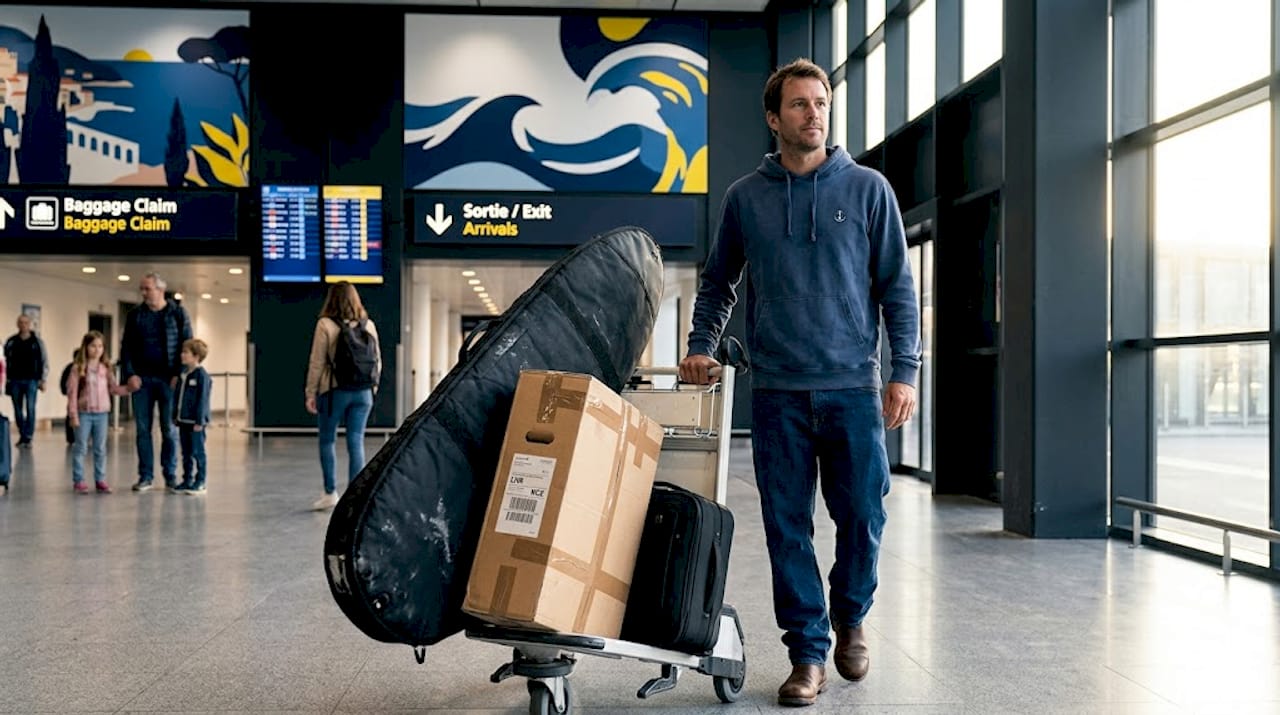
Arriving at Nice Airport with a surfboard or bike is one of those travel scenarios that sounds simple until you’re actually doing it. Between airline baggage policies, oversized fees, awkward transport logistics, and the question of where to store your gear, there’s a lot that can go wrong if you haven’t planned ahead. This guide covers everything you need to know: the policies that apply at Nice Côte d’Azur Airport, your best transport options once you land, local services worth knowing about, and the honest trade-offs between flying with your own gear versus renting locally.
Table of Contents
1. Arriving at Nice Airport with a surfboard or bike: what the policies actually say
2. Transporting your surfboard and bike from Nice Airport to your destination
3. Local services at and near Nice Airport for surfboard and bike handling
4. Flying with your gear versus renting or shipping: the honest comparison
5. Practical checklist for a smooth arrival with your equipment
My honest take on traveling with sports gear through Nice Airport
Getting from Nice Airport to your destination with your gear, stress-free
Key Takeaways
Point | Details |
Airline fees vary widely | Surfboard transport typically costs €150 to €300 round trip when you factor in fees and repair risk. |
Book private transfers early | Pre-booked vehicles with luggage capacity handle surfboards and bikes far better than standard taxis or public transit. |
Left luggage is available | Nice Airport’s Service Center allows temporary storage, open daily from 7am to 9pm. |
Renting locally saves hassle | Local shops near Nice offer quality bike and surfboard rentals, often cheaper than flying your own gear. |
Pack smart to avoid damage | Remove fins, wrap nose and tail carefully, and use a durable board bag to reduce the risk of airline damage. |
1. Arriving at Nice Airport with a surfboard or bike: what the policies actually say
Most travelers assume airlines have one unified policy for oversized sports gear. They don’t. And that gap between what you expect and what you find at check-in is where the stress begins.
Airlines classify surfboards as oversized sports equipment. Fees run from €30 to €150 per flight leg, which means a round trip can easily cost you €60 to €300 before you’ve bought a single meal. Weight limits typically sit between 20 and 32 kg, depending on the carrier.
Size limits are the sneakier issue. Airlines measure in linear inches, adding together length, width, and height of your packed bag, with a common maximum of 115 linear inches. A standard longboard bag, even without the board bulging out, can blow past that threshold without you realizing it.
Bikes are typically handled differently. They travel as checked sports equipment, often requiring you to deflate tires, remove the pedals, turn the handlebars, and pack the whole thing in a cardboard box or hard case. Many airlines allow bikes at the standard oversized fee if the total weight stays under their limit.
A few things to know before you get to the airport:
Budget airlines charge the most per leg and often have no liability for damage. Carriers like Emirates are notably more surfboard-friendly.
Nice Côte d’Azur Airport itself doesn’t impose separate equipment fees. The charges come from your airline, not the airport.
You’ll check oversized items at a dedicated oversize baggage counter, not the regular belt. Build extra time into your check-in for this.
When collecting your gear on arrival, oversize items come out at a separate carousel or designated area, usually marked clearly at baggage claim.
Pro Tip: Call your airline directly before booking to confirm their current surfboard or bike policy. Policies change seasonally, and the fee listed online isn’t always the fee applied at the counter.
2. Transporting your surfboard and bike from Nice Airport to your destination
Getting off the plane with a 6-foot board bag or a bike box is the moment most travelers underestimate. The challenge isn’t just physical. It’s also logistical.
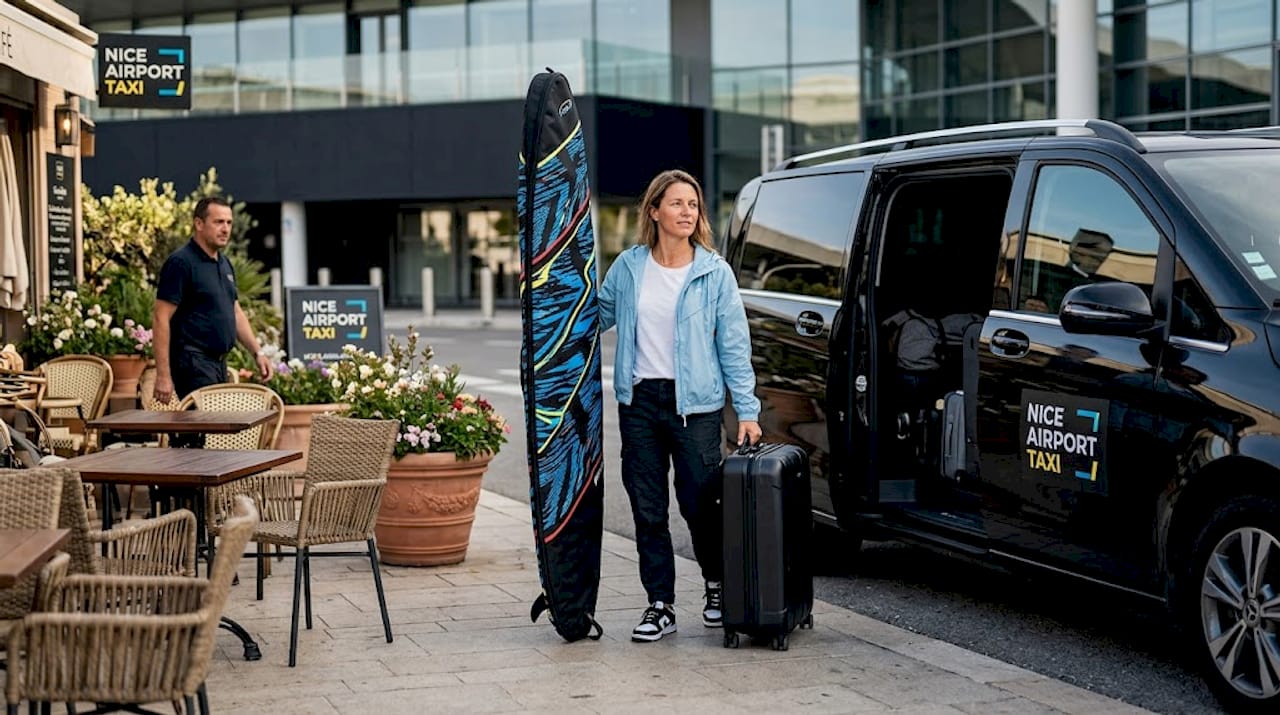
Standard taxis at Nice Airport are not equipped for oversized gear. A surfboard bag won’t fit in the trunk of a sedan, and most drivers won’t allow it in the passenger compartment due to liability. Bikes in hard cases pose the same problem. You could arrange a taxi van in theory, but doing this on the spot is unreliable. Drivers sometimes refuse, and you’re left negotiating at the curb with exhausted legs.
Public transport is worse. The Nice Airport tram line connects the airport to the city center, but there’s no realistic way to get a surfboard bag onto a tram without blocking other passengers and violating carriage rules. Buses share the same limitation.
Your best option by a wide margin is a pre-booked private transfer in a vehicle sized for your gear. Here’s why it works:
You specify your equipment in advance, so the driver arrives with the right vehicle, whether that’s an estate car, minivan, or people carrier.
Your driver monitors your flight in real time, meaning delays won’t leave your gear sitting on the curb.
Door-to-door service means no lugging a board bag through metro stations or bus stops.
Fixed pricing means no surge charges, no negotiating, and no surprises.
For getting your bike to the French Riviera without the usual headaches, this guide to bringing your bike covers the specifics in depth.
Pro Tip: When booking your private transfer, list every piece of oversized gear in the notes field. Drivers who know what’s coming can select the right vehicle and arrange the loading accordingly. Surprises at pickup slow everyone down.
Packing your gear for the road leg matters too. Keep your board bag zipped tight and use additional straps if possible. For bikes, make sure the case is sealed and that any protruding handles or pedals are tucked in before loading.
3. Local services at and near Nice Airport for surfboard and bike handling
You don’t have to solve everything before you land. Nice Airport and the surrounding area have several services worth knowing about.
Left luggage and storage at Nice Airport operates through the Service Center. It is open daily from 7am to 9pm. You can deposit a surfboard box or bike case temporarily, which is useful if you’re arriving early and your accommodation isn’t ready, or if you need to run into the city before heading to your final destination.
Bike boxes and packing supplies are available from several bike shops near the airport and in central Nice. Bike boxes typically cost from around €45, and many shops offer packing assistance. If you’re flying home with a rented bike, this is where you get your return box sorted.
Bike rental near Nice is genuinely good. The city and surrounding area have a strong cycling culture, and rental options range from basic city bikes to quality road and gravel setups. Advance booking is strongly recommended, particularly in summer. The selection at walk-in shops gets thin fast during peak weeks.
Surfboard rentals and storage near Nice require a bit more research. The closest surf spots to Nice are further along the coast, toward Biarritz or the Atlantic side. The Mediterranean near Nice is calmer and less suited to surfing, though some travelers use Nice as a transit point before heading elsewhere. If that’s your situation, renting a board at your surf destination rather than dragging yours from Nice is often the smarter call.
4. Flying with your gear versus renting or shipping: the honest comparison
This is where most surf and cycling travel guides go soft. They list the pros and cons but stop short of an actual recommendation. Here’s a direct comparison.
Factor | Flying with your gear | Renting locally | Shipping gear separately |
Cost | €150 to €300 round trip in fees | €30 to €80 per day for quality rental | High shipping cost plus insurance |
Convenience | Yours from departure to return | No carry hassle; pickup at shop | Requires precise timing |
Damage risk | High if airline mishandles | None | Possible in transit |
Availability | Always your own board or bike | Limited in peak season | Not an option last minute |
Best for | Precision surfers or custom bikes | Casual riders; first-time surf trips | Extended stays with advance planning |
The math on flying with a surfboard usually doesn’t favor it unless you’re committed to riding a specific board. Average round-trip costs, including fees and factoring in even a modest repair risk, run €150 to €300. A quality local rental for a week often costs less and comes without the airport stress.
Cyclists are a different case. If you ride a custom-fitted bike for performance, renting a shop bike that doesn’t fit you is genuinely limiting. Flying your own bike makes sense. If you’re touring for leisure, local rentals are perfectly adequate, and the French Riviera has the infrastructure to support it.
5. Practical checklist for a smooth arrival with your equipment
Here’s what to do before, during, and after your flight.
Before you book your flight: confirm your airline’s surfboard or bike policy directly. Don’t rely on third-party comparison sites for this information.
Before you pack: remove fins from your surfboard and wrap the nose and tail heavily with foam pipe insulation or bubble wrap. Use a hard bag if your board has value.
At check-in: arrive at least 30 minutes earlier than you normally would. Oversized items take longer to process, and late check-in for oversize bags is a frequent cause of denied boarding.
At baggage claim: oversized items come out separately. Look for signs at the airport directing you to the oversize carousel or designated collection point.
If your gear is lost or damaged: file a Property Irregularity Report immediately at the airport before you leave the terminal. Compensation under the Montreal Convention caps at approximately $1,500 USD, which is rarely enough to cover a quality surfboard or custom bike. Third-party insurance before you travel is the only real solution.
For your onward transfer: confirm your private transfer booking includes the correct vehicle type for your gear dimensions.
Pro Tip: Take photos of your surfboard or bike before you hand it over at check-in. Clear timestamped images of your gear in perfect condition are your strongest evidence in a damage claim.
My honest take on traveling with sports gear through Nice Airport
I’ve watched a lot of travelers arrive at Nice Airport looking confident with their board bags and bike boxes, and leave looking frazzled. The airport itself isn’t the problem. Nice Côte d’Azur is well-organized and easy to move through. The problems are almost always self-inflicted and fall into two categories: airline policy surprises and transport assumptions.
The biggest mistake I see is treating the airport transfer as an afterthought. People spend weeks agonizing over which board bag to buy, which airline is more surfboard-friendly, and how to pack their bike perfectly. Then they land at Nice with a 7-foot board bag and assume they’ll sort a ride on the spot. They can’t. And by the time that becomes clear, they’re standing at the curb with an awkward piece of gear and a long list of unhelpful options.
The second thing I’d say is this: renting locally saves more trips than people expect. If you’re cycling the Côte d’Azur for leisure or spending a week at a surf destination reachable from Nice, the math and the stress both point toward renting. Reserve your flights for performance-specific gear that genuinely can’t be substituted.
If something does go wrong, the airport’s Service Center is your first stop, not the airline hotline. Staff there can direct you to the right channels faster than holding on a customer service line.
— Rolands
Getting from Nice Airport to your destination with your gear, stress-free
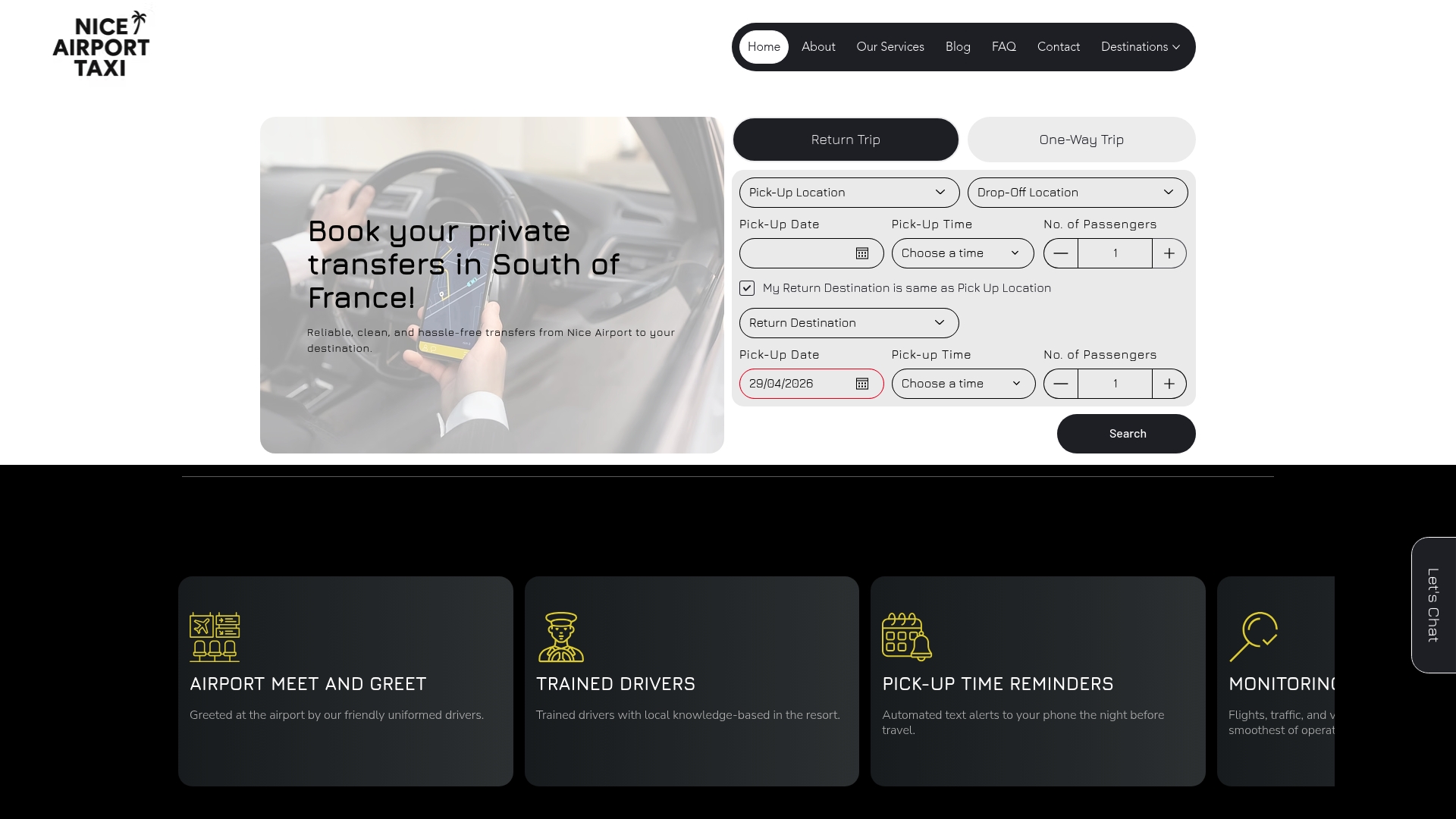
Nice-airport specializes in exactly this kind of transfer. When you’re traveling with sports gear Nice Airport arrivals create real logistical challenges, and a standard taxi simply isn’t built for them. Nice-airport’s private transfer service lets you specify your surfboards, bike cases, or any other oversized equipment at booking, so the right vehicle is waiting when you land. Drivers monitor your flight in real time and meet you at arrivals, ready to load and go. Fixed pricing means no surprises. For equipment-friendly airport transfers from Nice to Cannes, Monaco, Saint-Tropez, Antibes, or anywhere else on the French Riviera, book in advance at nice-airport.taxi, especially in peak summer months when availability is limited.
FAQ
How much does it cost to fly with a surfboard to Nice?
Expect to pay €30 to €150 per flight leg in airline fees, making a round trip anywhere from €60 to €300 depending on your carrier.
Can I take a regular taxi from Nice Airport with a surfboard?
Standard taxis at Nice Airport are not suitable for surfboards or bike cases. You need to pre-book a minivan or private transfer that can accommodate oversized equipment.
Does Nice Airport have storage for surfboards or bike boxes?
Yes. Nice Airport’s Service Center offers left luggage storage open daily from 7am to 9pm, where you can deposit oversized items like surfboard boxes or bike cases.
What should I do if my surfboard is damaged or lost at Nice Airport?
File a Property Irregularity Report immediately before leaving the terminal. Compensation under the Montreal Convention caps at around $1,500 USD, so third-party travel insurance covering your gear is strongly recommended.
Is it better to rent a bike in Nice or fly with my own?
For leisure cycling, renting locally is usually cheaper and less stressful than paying airline fees. For performance riding on a custom-fitted bike, flying your own is worth it. Bike boxes near Nice typically cost from €45 if you need to pack for the return journey.
Recommended
Comments